Published By BHF | July 21, 2026
By: Tatumwa Desmond Benjamin
Under the Child Thrive Project, local radio stations are being used to bring conversations about children’s rights closer to communities. Through interactive talk shows, listeners are learning what children’s rights mean, why they matter and how individuals and institutions can protect and fulfil them.
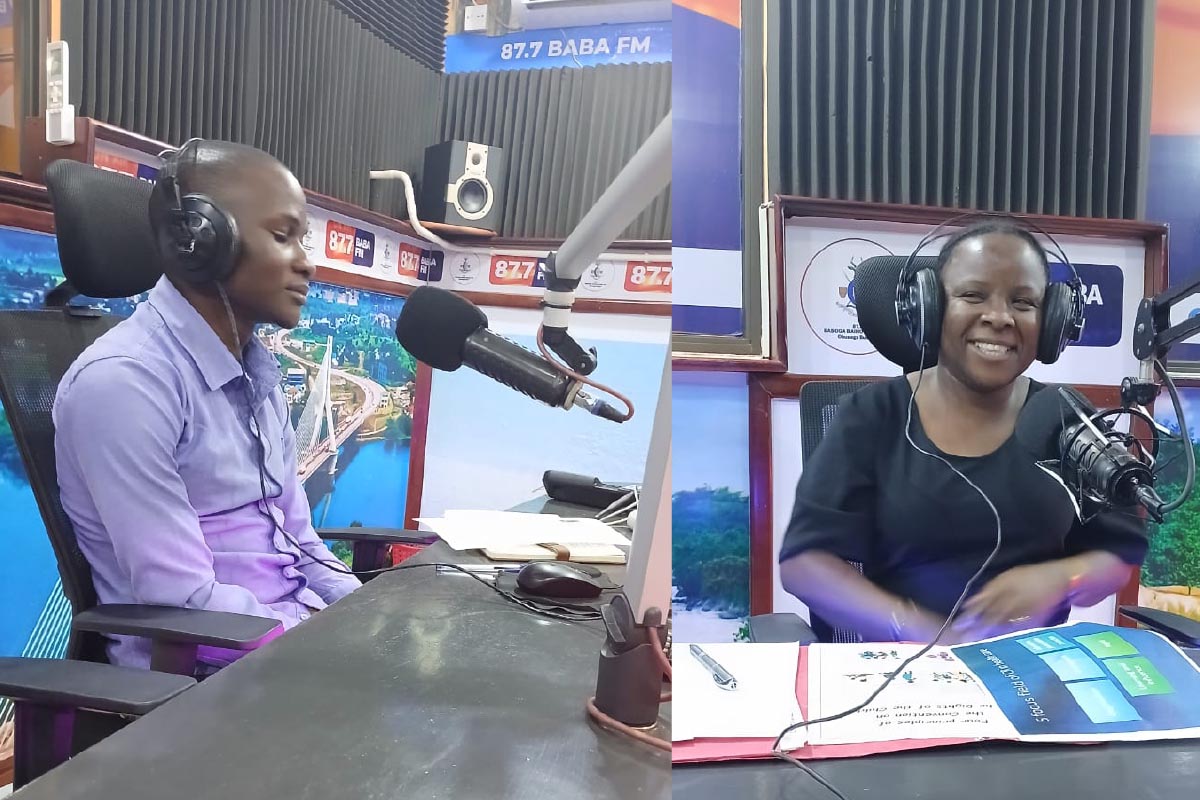
One of these engagements was held on BABA FM Radio, where Sam Sabagereka, a Psychiatric Clinical Officer, and Allen Nabisere, a Medical Clinical Officer at Jinja Regional Referral Hospital, discussed children’s rights with listeners. The programme provided an opportunity to move the conversation beyond healthcare facilities and directly into homes and communities across Busoga.
Children have rights in every area of life
During the talk show, the presenters explained that children’s rights cover the whole life of a child. They include the rights to education, healthcare, protection, dignity, equality, development, play and participation in decisions affecting them.
Children’s rights are legally protected entitlements and freedoms mainly established through the United Nations Convention on the Rights of the Child. They are intended to promote the survival, development, protection and participation of every person below the age of 18. Children are not simply future adults; they are individuals with their own needs, experiences, views and voices in the present.
The discussion placed particular emphasis on a child’s right to participate and express an opinion. Children should be allowed to give their views on matters affecting their lives, and those views should be considered according to their age and maturity.
This also applies in healthcare settings. Health workers should not communicate only with parents or caregivers while ignoring the child receiving care. Children should be given information in language they can understand, allowed to ask questions and encouraged to express their fears, concerns and preferences.
When a healthcare worker recommends an examination, treatment, admission, referral or medical procedure, the child should receive an age-appropriate explanation of what is happening and why the decision is being made. Listening to children does not remove the responsibility of parents and health professionals. Instead, it helps ensure that decisions are made respectfully and with the child’s best interests at the centre.
The Child Rights Ambassador Toolbox highlights non-discrimination, the best interests of the child, life and development, participation, protection from harmful work and abuse, access to healthcare, inclusion of children with disabilities, and the right to play and rest as important children’s rights.
The callers brought real community concerns to the discussion
The strength of local radio is that communication does not move in only one direction. Listeners can call, ask questions, share experiences and draw attention to situations affecting children in their communities.
During the BABA FM talk show, one caller from Iganga raised concern about children in villages who are involved in labour, including cutting sugar cane. The caller explained that some of the affected children are orphans who have dropped out of school. He wanted to know whether there was an office or organisation that could support them to leave harmful labour and return to school.
His concern demonstrated that awareness about children’s rights must be connected to clear reporting and referral pathways. It is not enough for communities to recognise that a child is being exploited. They must also know where to report the case and how the child can be linked to protection, education and social support.
Children involved in harmful work, children who have dropped out of school and children without adequate parental care may require support from several actors. These include local council leaders, community development officers, the District Probation and Social Welfare Office, and the Child and Family Protection Unit of the Uganda Police Force. Uganda’s child-protection structures also include the government-operated Sauti 116 Uganda Child Helpline, through which children and adults can report abuse and other violations of children’s rights. (Uganda Police Force)
The Child Thrive Project therefore seeks to work through existing government and community structures rather than establish parallel systems. Trained Child Rights Ambassadors can raise awareness, identify concerns and help guide families towards the appropriate authorities and services.
Addressing pregnancy and childbirth among children
Another important contribution came from David Jumba of Nakilulwe in Iganga District, who asked what could be done to reduce the number of children becoming pregnant and giving birth before the age of 18 in Busoga.
His question highlighted a serious child-rights concern that requires action from families, schools, healthcare providers, communities and government institutions. Preventing pregnancy among children requires more than telling young people to avoid sexual activity. Communities must address the conditions that place children at risk, including sexual violence, exploitation, school dropout, harmful social norms, inadequate parental guidance and limited access to reliable, age-appropriate health information.
Parents and caregivers should create environments in which children can speak openly about concerns without fear of punishment or shame. Schools should provide safe learning environments and identify children who may be at risk of dropping out. Health facilities should provide respectful and adolescent-responsive services, while police, probation officers and local leaders must respond appropriately when abuse, exploitation or other violations are reported.
Most importantly, the child must not be blamed. Children facing pregnancy, violence or exploitation need protection, appropriate healthcare, counselling, education support and access to justice.
Why local radios matter
Local radio stations remain among the most accessible communication platforms in Uganda. They reach listeners in towns, trading centres and villages, including people who may not have regular access to smartphones, social media or formal training opportunities.
Radio programmes can reach parents while they are at home, farmers working in the fields, drivers on the road, health workers travelling from duty and community leaders in remote areas. Discussions can also be delivered in languages that communities understand best, making complex legal and health information more practical and relatable.
Radio also gives communities an opportunity to shape the discussion. The calls received during the BABA FM programme showed that listeners were not only interested in definitions of children’s rights. They wanted practical answers about child labour, school dropout, orphaned children, pregnancy among children and the institutions responsible for helping affected families.
This interaction helps transform children’s rights from an abstract concept into an everyday community responsibility.
Building a network of Child Rights Ambassadors
The radio engagements are supported by the wider work of the Child Rights Ambassadors Programme. So far, the project has trained 112 Child Rights Ambassadors through four cohorts.
The ambassadors are equipped with knowledge and practical skills to promote children’s rights within healthcare facilities and communities. Their responsibilities include educating and supporting colleagues, promoting children’s participation, identifying practices that may violate children’s rights and encouraging institutions to improve how they communicate and interact with children.
The programme is intended to produce visible changes in attitudes and practice—not merely certificates. The Child Rights Ambassador Toolbox emphasises that trained ambassadors should drive child-rights work within their workplaces, monitor whether children’s rights are respected, support institutional leaders and collect children’s views to inform improvements.
The impact of the programme will therefore be seen when a health worker speaks directly to a child, when an examination is explained before it is conducted, when a child’s privacy is respected, when children with disabilities receive inclusive services and when children’s opinions influence decisions about the services intended for them.
The Child Thrive partnership
The Child Thrive Project is built around a partnership between Ugandan and Swedish local governments, healthcare institutions and civil society organisations. It uses Sustainable Development Goal 3—Good Health and Well-being as its point of departure and aims to improve children’s ability to survive, thrive and reach their full potential.
Its four interconnected areas are neonatal care, paediatric emergency and critical care, care for children with developmental or neurological conditions, and the strengthening of children’s rights in healthcare. (ICLD)
The partners have complementary roles:
The Swedish International Centre for Local Democracy funds the partnership and provides a local-democracy framework centred on equity and inclusion, transparency, accountability and citizen participation. Through this approach, children and their caregivers are recognised not only as service users but also as citizens whose experiences and opinions should influence local services.
Region Stockholm, through Astrid Lindgren Children’s Hospital, is the Swedish local-government and healthcare partner. It contributes paediatric expertise, professional exchange, training, mentorship and joint learning in the project’s clinical and child-rights areas.
Jinja City provides local-government leadership and helps connect the project to local planning, public services, accountability structures and community priorities.
Jinja Regional Referral Hospital, including Nalufenya Children’s Hospital, serves as a major clinical implementation and learning site. Its health workers and leaders participate in training, mentorship and practical improvements aimed at making healthcare safer, more responsive and more respectful of children.
Busoga Health Forum supports local coordination, communication, health-worker engagement, documentation and community awareness. Its role includes taking children’s rights information beyond health facilities through platforms such as local radio talk shows.
Pediatric Health Initiative supports the collaboration between the Ugandan and Swedish partners, including technical exchange, coordination, training and the implementation of improvements in paediatric healthcare.
The Child Rights Ambassador Programme was developed within this partnership by teams from Astrid Lindgren Children’s Hospital and Jinja Regional Referral Hospital/Nalufenya Children’s Hospital, working with Pediatric Health Initiative and Busoga Health Forum.
From awareness to collective action
A radio talk show cannot solve every challenge affecting children. However, it can begin conversations, correct misunderstandings, help communities recognise violations and direct vulnerable children towards support.
The voices from Iganga showed why these conversations must continue. Communities are seeing children involved in harmful labour, children out of school, orphans needing support and children becoming parents before reaching adulthood. They need accessible information and confidence that existing institutions will listen and respond.
By combining the reach of local radio stations, the knowledge of 112 trained Child Rights Ambassadors, and established government structures such as probation offices, community development departments and the police’s Child and Family Protection Unit, the Child Thrive Project is helping move children’s rights from awareness to action.
Protecting children is not the responsibility of one organisation, one health worker or one parent. It requires families, communities, healthcare institutions, schools, government departments, civil society and children themselves to work together.
Every child has the right to be protected, educated, respected and heard. Every child deserves the opportunity to survive, thrive and reach their full potential.